Tech Neck, Narrowed: How Posture Rewrites Your Jawline and Facial Fluid
Not another “put your phone down” lecture. Where the load actually goes, why fluid stalls, and the three corrections with evidence behind them.
Last updated October 19, 2026 · by the Haismeda editorial team

Six-ish in the evening is when I catch it. Not in the mirror — in the dark second monitor, while a build runs. Jaw forward, right shoulder somewhere near my ear, and the line under my chin visibly softer than it was at nine in the morning. Same face, same lunch, seven hours of sleep. The only thing that changed is the angle of my skull, which has been parked at roughly twenty-five degrees since the first meeting.
I wanted to know whether that impression survives being measured, so I ran it properly: two weeks, a kitchen timer, my partner as a mostly unwilling witness, and one photo rule that I broke exactly once. What follows is the mechanics of what was happening — and the parts of my own test that worked, which is fewer parts than I expected.
What is tech neck, mechanically?
It is a lever problem, not a laziness problem. Your skull is a weight on top of a column, and every degree of forward tilt moves the centre of gravity in front of the spine — which multiplies the load the neck carries.
The numbers come from a biomechanical analysis of the cervical spine. A neutral adult head weighs roughly 4.5 to 5.5 kg. At 15 degrees of flexion the effective load climbs to about 12 kg; at 30 degrees, 18 kg; at 60 degrees — the angle of a phone in your lap — about 27 kg (Hansraj, Surgical Technology International, 2014). Same head, same neck, different lever.
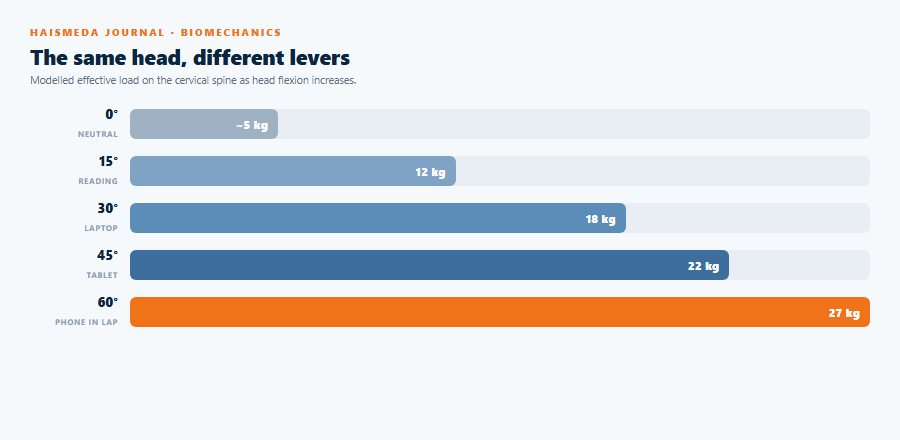
Spine surgeons started giving this posture a name because young patients — people who should not have spine problems yet — began arriving with disc and alignment changes consistent with hours of daily flexion (Cuéllar & Lanman, The Spine Journal, 2017).
Does looking down really change your jawline?
Not bone, and not overnight — but yes, measurably, through two pathways.
Pathway one is muscular. The platysma — the broad sheet running from your jaw down over the collarbone — and the deep neck flexors sit exactly where a flexed posture compresses them. Hours in a shortened position teaches the front of the neck to stay short while the deep stabilisers switch off. The posture you hold at the desk becomes the posture you default to standing. On top of that, neck skin loses firmness and elasticity measurably with age (Aesthetic Plastic Surgery, 2022), so a chronically slack soft-tissue layer has less structural backup than it did a decade ago.
Pathway two is fluid, and it is the one people notice by Friday. The face drains downward through nodes at the jaw, ear and neck, and that system has no heart behind it — it runs on breathing, muscle motion and position changes. A locked screen posture removes all three at once, right where the drainage corridor narrows. The result is a soft fullness under the jaw and around the eyes that is not fat and not age; it is a queue.
How big is the appearance effect? Honestly: the load and the posture are well measured, the downstream facial change is a credible mechanism with no precise number attached. Anyone quoting percentages is improvising. But the direction is not in doubt, and unlike most cosmetic complaints this one has an input you control by the hour.
Why stillness matters more than angle
Here is the part most tech-neck articles miss: the pump is motion, not position. Lymph moves because you breathe deeply, because muscles contract around the vessels, and because you change shape often. Sitting at 25 degrees with hourly movement beats sitting bolt upright for four hours without moving. If you remember one thing, remember that the drainage map in the drainage map in our first article and the pump that runs it both live in the same few centimetres of neck — and stillness starves them together.
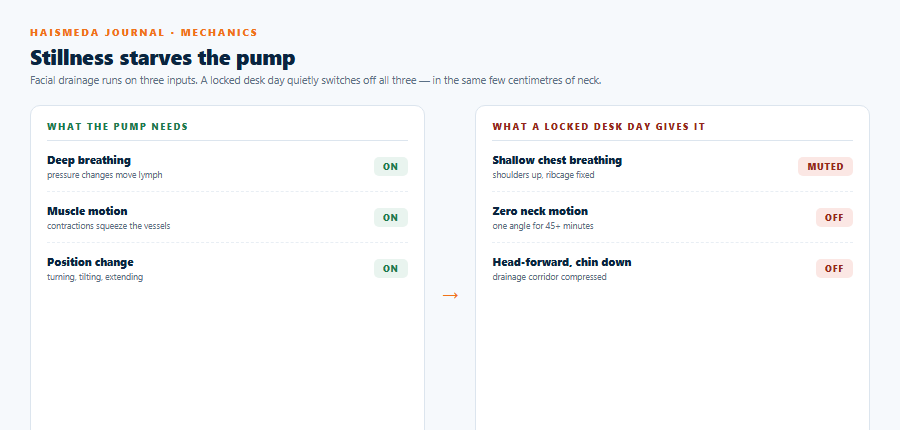
This is why the fix is scheduled motion, not perfect posture. Nobody holds perfect posture. Everybody can move for sixty seconds.
Can you undo it? Three corrections, ranked by evidence
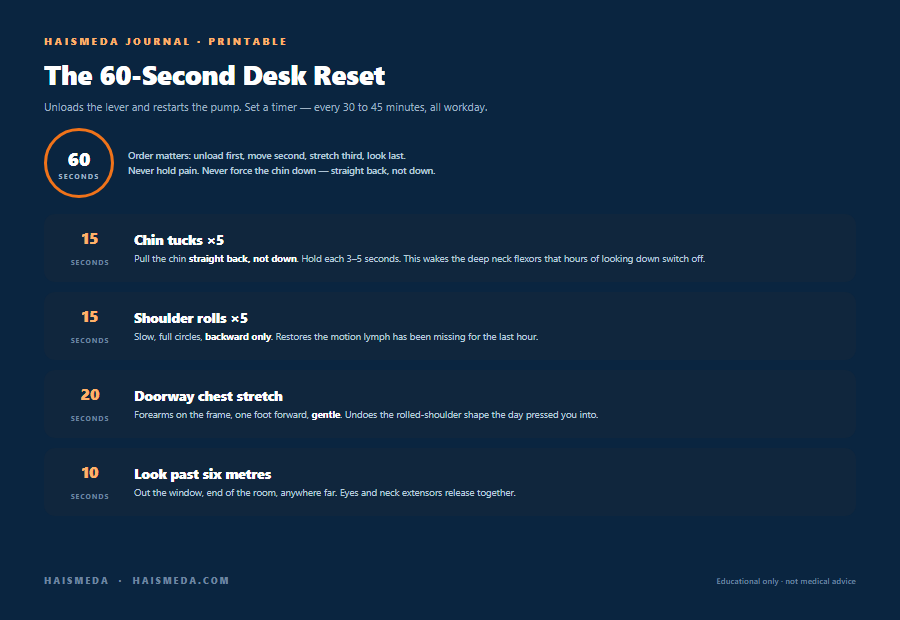
1. Break the stillness — the highest-value change, and it costs nothing. Every 30 to 45 minutes, stand up or at least change shape for 60 seconds: five slow chin tucks, five shoulder rolls, twenty seconds of chest stretch, and look at something more than six metres away. This is the intervention with the clearest mechanism behind it — it restarts the pump and unloads the lever at the same time.
2. Train the deep neck flexors. The chin tuck done properly — chin straight back, not down, held five seconds, ten repetitions — is the exercise physiotherapists actually prescribe for forward head posture, because it reactivates the stabilisers that hours of flexion switch off. Evidence for posture and neck symptoms: good. Evidence that it changes how your jawline looks: indirect, and slower than pathway one. Do it for the mechanism, not the mirror.
3. Move the screen, not the neck. Monitor at eye level, phone raised toward the face rather than the face dropped toward the phone, two hands instead of one. Surgeons who study text neck recommend exactly this: reduce the angle at the source instead of paying for it hourly.
And what does not work: passive posture braces (they hold you without teaching anything, and the deep flexors stay asleep), “double chin exercises” aimed at fat (submental fullness here is mostly fluid and posture, not fat), and any roller or massage tool promising structural change. The honest framing from our first article, Why Your Face Looks Tired Before Your Body Does applies: devices and tools work, at best, on the fast layer.
What the two weeks actually looked like
The protocol was deliberately boring: a baseline photo (same room, 8:15 am, same wall, front-on and side-on), the sixty-second reset on workdays, ten evening chin tucks, and the monitor raised onto a box that used to hold A4 paper. Day fourteen, same settings, second photo. One thing to judge: fullness under the jaw and around the eyes.
Day 1. Baseline. Forgot the midday reset twice, which tells you something about my actual baseline.
Day 2. Chin tucks feel ridiculous. Monitor box measured at 11 cm, which I only checked because the screen still sat below my eyes.
Day 3. Woke up marginally less puffy. Too early to believe it — could be last night’s dinner being lower in salt. Noted, not counted.
Day 4. Missed the reset for a deadline. The 6 pm difference was obvious, which is annoyingly convincing: the variable is the motion, not the posture.
Day 6. My partner commented on the jaw without being told what I was testing. Small sample of one skeptical observer, but it counted for something.
Day 8. Nothing new. Plateau. This is the point where I nearly stopped writing it down.
Day 11. Slept five hours; puffy regardless of everything. Posture is not magic, and a good night beats a good desk.
Day 14. Photos compared. The morning change is small but real. The 6 pm change is easier to see than the morning one — the fluid moves first, exactly where the mechanism says it should.
Takeaway: the contour did not change in two weeks, and I would distrust anything that claims it could. The fluid did. That split — fast layer moves, slow layer waits — is the whole story, and it is the same split described in the tier system in our first article, Why Your Face Looks Tired Before Your Body Does.
What I got wrong the first time
The chin tuck, for three days. I pulled the chin down, stretching the back of the neck, which is the common version and the wrong one. Straight back, like making a double chin on purpose. Three wasted days before I checked.
The screen, but not the phone. I raised the monitor and then spent the evenings reading with the phone in my lap at the exact angle this article is about. Half the inputs, half the results.
I nearly bought a posture brace. Good thing I read how they work first: they hold you passively, so the deep stabilisers stay asleep — the opposite of the adaptation you are trying to train.
One honest caveat
Posture will not rewrite bone, redistribute fat, or reverse skin laxity — those are the slow layer, and they respond to sunscreen and years, not to effort. If the fullness under your jaw persists no matter what your posture, sleep and hydration look like, that is worth a conversation with a clinician, not a firmer pillow. And any numbness, radiating pain or persistent stiffness is a medical question, not a cosmetic one.
Questions people actually ask
How long until posture changes show on my face?
Fluid changes fastest — most people notice reduced end-of-day and morning fullness within a week of consistent breaks and setup changes. Muscle tone shifts over weeks. Structural contour is a years-long matter and mostly belongs to sunscreen and genetics.
Is the 27-kilogram figure real?
It is a biomechanical model, not a scale reading: at 60 degrees of forward flexion, the effective load on the cervical spine is calculated at roughly 27 kg, versus about 5 kg neutral. The model is widely cited and the direction — load multiplies with angle — is not controversial.
Do posture corrector braces work?
For appearance and for learning: no. They hold you passively, so the deep stabilising muscles stay switched off — the opposite of training. Short-term use as a reminder is harmless; as a solution it is a crutch.
Can exercises remove a double chin?
If the fullness is fluid and postural — the kind that appears by evening and improves after sleep — then yes, motion and drainage beats it fairly quickly. If it is submental fat, exercises will not move it; that is anatomy, and it belongs to a clinician’s conversation.
When is it not posture?
When it does not track with your day. Fullness that ignores sleep, breaks and hydration, or any numbness, radiating pain, lumps or persistent stiffness, deserves a clinical look rather than another month of chin tucks.
References
Hansraj KK. Assessment of stresses in the cervical spine caused by posture and position of the head. Surgical Technology International. 2014;25:277–279.
Cuéllar JM, Lanman TH. Text neck: an epidemic of the modern era of cell phones? The Spine Journal. 2017;17(6):901–902.
Aging of the Neck Decoded: New Insights for Minimally Invasive Treatments. Aesthetic Plastic Surgery. 2022;46(4). PMID: 35701594. doi:10.1007/s00266-022-02961-0.
Standring S, ed. Gray’s Anatomy: The Anatomical Basis of Clinical Practice. 42nd ed. Elsevier; 2020 (platysma, deep cervical fascia, lymphatic drainage of the head and neck).


Comments
Post a Comment