Why Your Face Looks Tired Before Your Body Does
Muscle tension, lymph flow, and the quiet mechanics behind a face that reads as exhausted — even when you feel fine.

I noticed it on a Thursday, in the corner of a video call where my own camera feed sits. Not a wrinkle, exactly. More like the whole lower half of my face had gone quiet — jaw heavy, eyelids low, a soft puffiness under the eyes that no amount of concealer was going to argue with. I had slept seven hours. I felt fine. My face had apparently not received the memo.
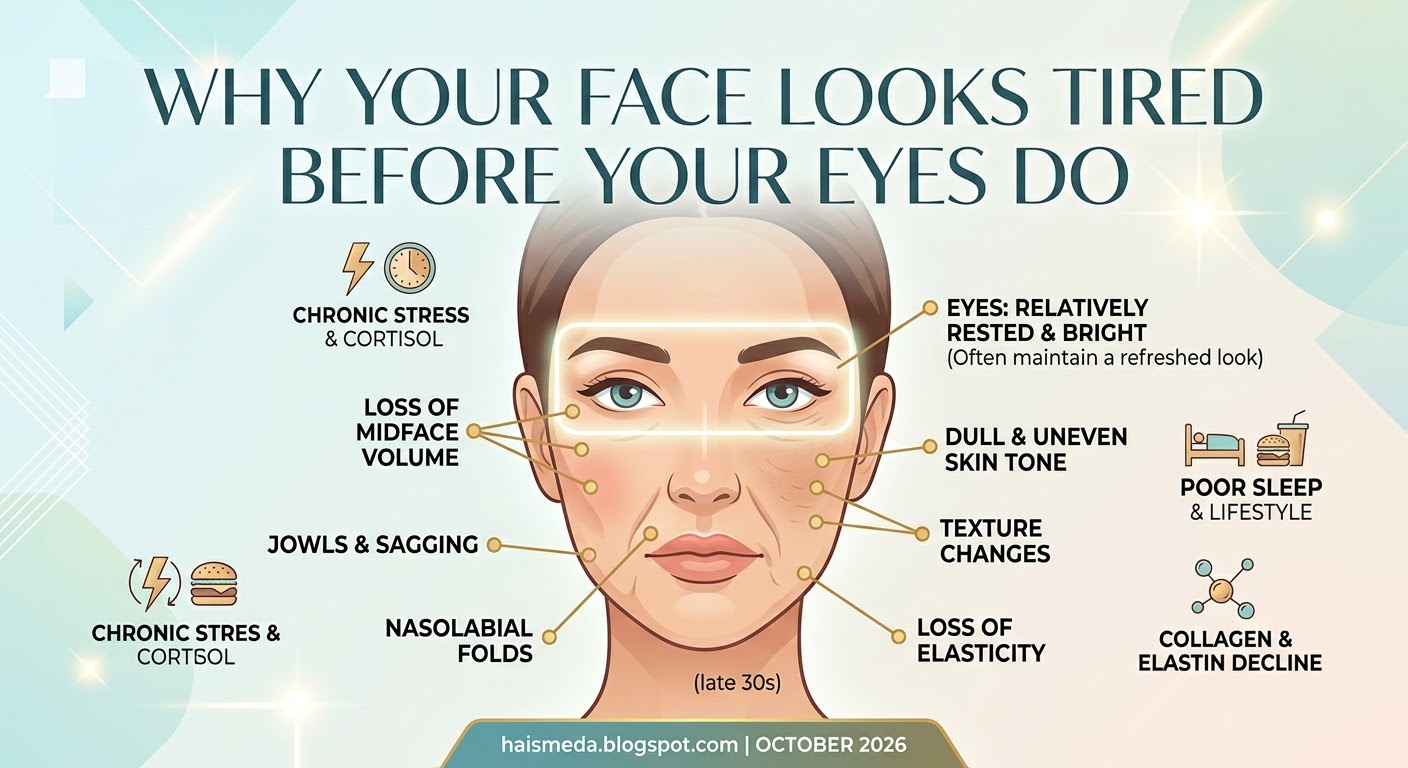
That gap — between how you feel and how you look — is not imaginary, and it is not vanity. It has mechanics. Once you know them, the fixes stop being about buying a better cream and start being about a small number of boring, repeatable things.
Forty-odd muscles that attach to your skin
Most skeletal muscles in your body run from bone to bone. The muscles of facial expression do something stranger: they insert into skin. That single anatomical fact is why emotional state and physical tension are legible on your face at conversational distance.
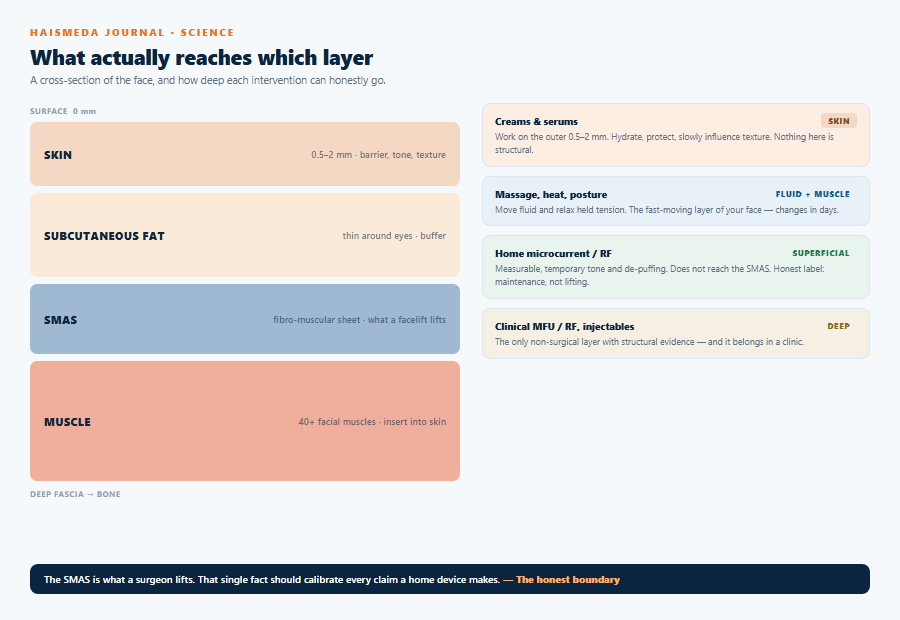
Between those muscles and the surface sits a layered system. Skin, then subcutaneous fat, then a fibro-muscular sheet — the superficial musculoaponeurotic system, or SMAS — then deeper fascia. The SMAS couples what the muscles do to what the skin shows. It is also the layer a surgeon lifts in a facelift, which tells you something about how deep a cream actually reaches.
The neck is part of the same system, not a separate address. The platysma is a broad sheet running from the jaw and lower face down over the collarbone, continuous with the fascial layer above. Which means: clench your jaw through an hour of concentrated work, and you are not only loading your teeth. You are holding tension in a structure that shares real estate with your neck and your lower face.
Why the face shows it first
Three reasons, all structural.
First, the skin is thin — eyelid skin is well under a millimetre — and the area around the eyes carries very little subcutaneous fat. There is almost nothing there to buffer what happens underneath.
Second, drainage is concentrated. Fluid from the face drains through a relatively small number of lymph nodes near the jaw, behind the ear, and down the neck. A low-volume system with few exits shows backlog quickly.
Third, we are extremely good at reading fatigue in other people. In a well-known sleep study, participants rated the faces of sleep-deprived people as significantly more tired and less healthy — and they did it from photographs, quickly, with high agreement. The features driving that judgement were specific: hanging eyelids, redder eyes, darker circles under the eyes, more fine lines (Sundelin et al., Sleep, 2013).
So “you look tired” is not a comment on your character. It is other people’s visual system doing exactly what it evolved to do.
The neck is the drain, not just the frame
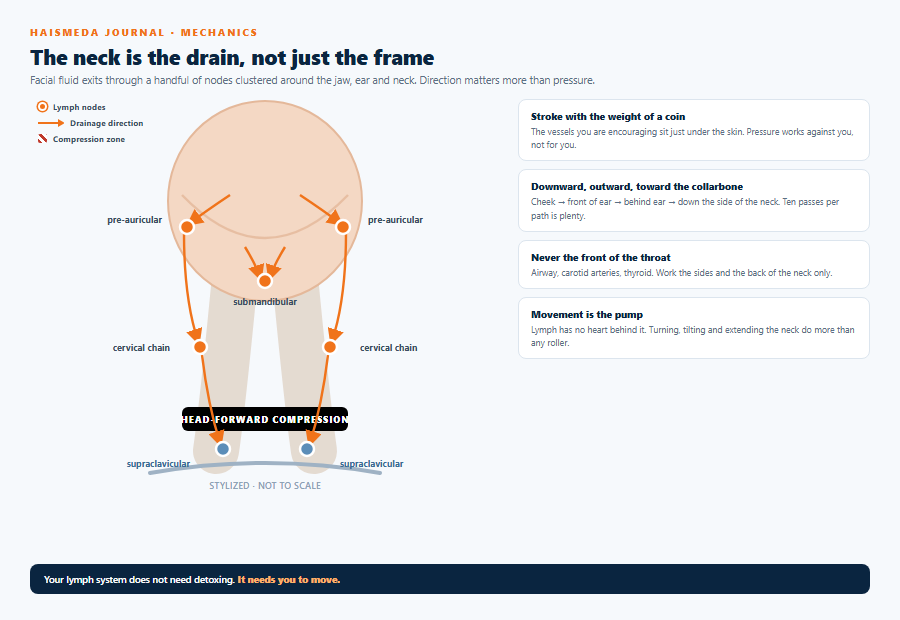
Lymph does not have a heart behind it. It moves because you breathe, because muscles contract around vessels, because you change position. Compression and stillness are its two enemies.
Now consider the posture most of us hold for six hours a day: head forward, chin down, shoulders rolled. Two things happen at once. The base of the neck — where the deep cervical nodes sit — is mechanically compressed. And the small movements that normally pump fluid (turning, tilting, extending) stop happening.
The load numbers are worth knowing. In a neutral position an adult head weighs roughly 4.5 to 5.5 kg. At 15 degrees of forward flexion, the effective load on the cervical spine rises to about 12 kg. At 60 degrees — the angle of a phone in your lap — it is closer to 27 kg. That is not a metaphor: it is the same head, on the same neck, with a different lever (Hansraj, Surgical Technology International, 2014).
Spine surgeons have been documenting the consequences for years, and gave it a name: text neck. Their concern is that sustained flexion is showing up as disc and alignment problems in patients far too young to have earned them (Cuéllar & Lanman, The Spine Journal, 2017).
What is well established is the load and the posture. What is plausible but less settled is the downstream effect on how the face looks. The mechanism is credible — compressed drainage routes plus less movement equals slower clearance — but if someone tells you the exact percentage by which slouching ages your jawline, they are making it up. I would rather give you the mechanism and let you judge your own Monday.
Sleep moves the needle more than any device
Sleep loss shows up on the face before it shows up in a blood test. Barrier recovery slows, water loss through the skin increases, and the area around the eyes — already the thinnest skin on your body — collects fluid. Add the pallor of a bad night and you get that specific grey that reads as “unwell” rather than “tired”.
The practical version is unglamorous: a consistent window, seven to nine hours depending on the person, and your head slightly elevated. If you wake up puffy every single morning, that is information, not a skincare problem.
What actually helps, ranked honestly
I will use three tiers, because pretending everything is equally proven is how the wellness industry got its reputation.
Tier one — boring, well supported. Daily sunscreen; photoaging is the main driver of skin laxity, full stop. Not smoking. Sleep regularity. Breaking up long static posture every 30 to 45 minutes, even for sixty seconds. None of this is exciting, and together they account for most of the difference between faces at fifty.
Tier two — reasonable evidence, modest effect. Gentle manual work on the jaw and neck muscles reduces subjective tension and produces a short-lived improvement in how the lower face looks — mostly through fluid and muscle tone, not structure. Warmth does something similar: a warm compress relaxes muscle and increases local blood flow for a while. Both are worth ten minutes. Neither is a treatment.
Tier three — plausible but oversold. At-home microcurrent and radiofrequency devices produce measurable, temporary changes in puffiness and tone. What they do not do is reach the SMAS or rebuild collagen at the depth a clinical device does. The honest framing is “good for the fast-moving layer of your face”, not “non-surgical facelift”.
And what is not supported: “releasing fascia” as a manual technique with lasting structural change, rollers that “stimulate collagen” through pressure alone, and anything sold as lymphatic “detox”. Your lymph system does not need detoxing. It needs you to move.
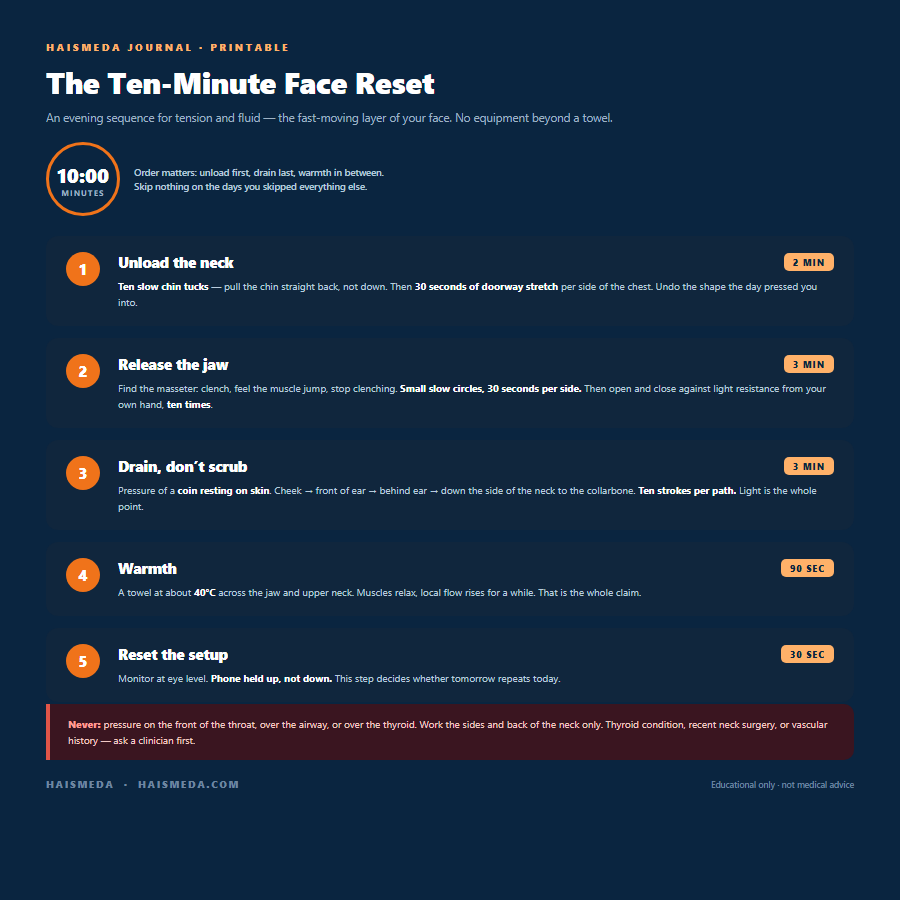
A ten-minute evening sequence
This is the version I actually do, and it assumes no equipment beyond a towel.
1. Unload the neck (2 minutes). Ten slow chin tucks — pull the chin straight back, not down. Then thirty seconds of doorway stretch for each side of the chest. The point is to undo the shape the day pressed you into.
2. Release the jaw (3 minutes). Find the masseter: clench, feel the muscle jump at the corner of your jaw, then stop clenching. Small slow circles with two fingertips, thirty seconds each side. Then open and close the mouth against light resistance from your own hand, ten times.
3. Drain, do not scrub (3 minutes). With the pressure of a coin resting on skin, stroke from the centre of the face outward and downward: cheek toward the front of the ear, then behind the ear, then straight down the side of the neck to the collarbone. Ten strokes per path. Light pressure only — this is about the vessels just under the skin, not the muscle.
4. Warmth (90 seconds). A towel at about 40°C across the jaw and upper neck. Never the front of the throat, and never over the airway.
5. Reset the setup (30 seconds). Monitor at eye level. Phone held up, not down. This is the step that decides whether tomorrow repeats today.
One honest caveat
Your face is not a muscle you can train into firmness. Tension and fluid are the fast layer — they can change in a week, and most of what a good routine does lives there. Structure is the slow layer: collagen, elastin, bone, and the SMAS. That layer moves over years, and it responds to sun protection, not to effort.
Knowing which layer you are working on is the whole game. It is also the difference between a routine you keep and a shelf of things that promised more than they could deliver.
Questions people actually ask
Why does my face look tired when I don’t feel tired?
Because “looking tired” is read from a small set of visual cues — eyelid position, under-eye darkness, skin pallor, fine lines — that respond to fluid, muscle tone and blood flow. None of those require you to feel exhausted. A stiff neck and a long screen day can produce them on their own.
Can neck tension really affect my face?
Mechanically, the neck is the drainage corridor for the face, and the platysma connects the lower face to the collarbone. Sustained head-forward posture compresses that corridor and reduces the small movements that help fluid clear. The link between posture and appearance is credible and partly measured; the size of the effect is not precisely known.
Do I need a device for any of this?
No. Sunscreen, sleep regularity and breaking up static posture do more for how your face ages than any at-home device. Devices are useful for the fast layer — puffiness and tone — and should be judged on that, not on “lifting”.
How long until I notice a difference?
Fluid and muscle tension can change within a week of consistent routine. Texture and tone take eight to twelve weeks. Structural laxity is a years-long conversation and mostly belongs to a clinician, not a routine.
Is it safe to massage the front of the neck?
Not with pressure. The front of the neck contains the airway, the carotid arteries and the thyroid. Work the sides and the back of the neck, and keep lymph strokes light and directed downward toward the collarbone. If you have a thyroid condition, recent neck surgery, or any vascular history, ask a clinician first.
References
Sundelin T, Lekander M, Kecklund G, Van Someren EJW, Olsson A, Axelsson J. Cues of fatigue: effects of sleep deprivation on facial appearance. Sleep. 2013;36(9):1355–1360. PMID: 23997373.
Hansraj KK. Assessment of stresses in the cervical spine caused by posture and position of the head. Surgical Technology International. 2014;25:277–279.
Cuéllar JM, Lanman TH. Text neck: an epidemic of the modern era of cell phones? The Spine Journal. 2017;17(6):901–902.
Aging of the Neck Decoded: New Insights for Minimally Invasive Treatments. Aesthetic Plastic Surgery. 2022;46(4). PMID: 35701594. doi:10.1007/s00266-022-02961-0.
Neck Rejuvenation Using a Combination Approach: Our Experience and a Review of the Literature. Dermatologic Surgery. 2016;42(Suppl 2). PMID: 27128251. doi:10.1097/DSS.0000000000000699.
Standring S, ed. Gray’s Anatomy: The Anatomical Basis of Clinical Practice. 42nd ed. Elsevier; 2020 (facial muscles, platysma, superficial fascial layers of the face and neck).


Comments
Post a Comment