Why You Wake Up Puffy: Morning Fluid and What Moves It
Twenty-one photographs, taken at the same minute each morning, in the same window. The left eye was worse in sixteen of them. That is why this article is not about eye cream.
Last updated October 20, 2026 · by the Haismeda editorial team
6:41. The left eye is worse. Not dramatically — a millimetre or two of extra fold below the lid, and a shadow where the cheek meets the socket — but consistent enough that I started photographing my face at the same minute each morning, in the same window, before washing it. Twenty-one photographs so far. The left eye is worse in sixteen of them.
That number is the reason this article is not about eye cream. If puffiness were a skin problem, it would not care which side I slept on.
What is morning puffiness, actually?
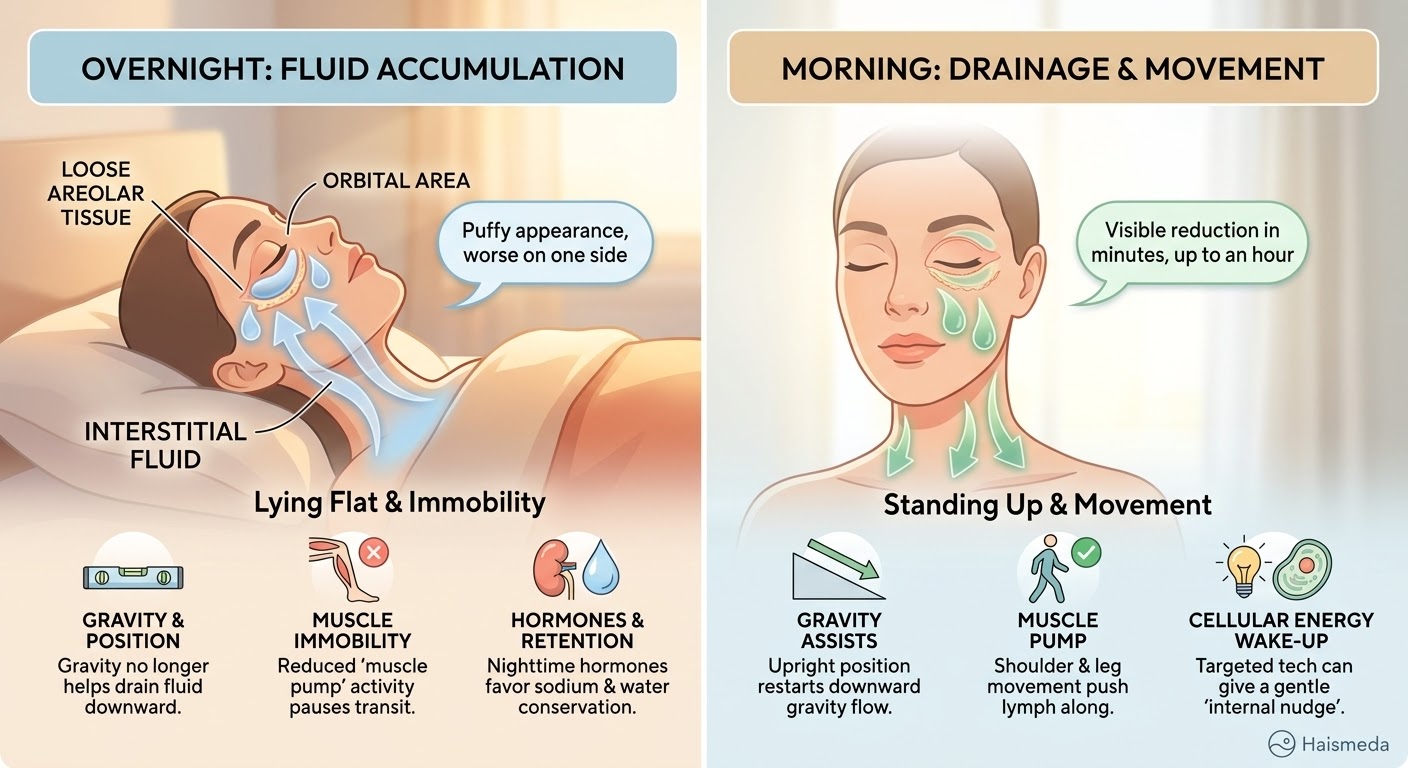
Morning puffiness is interstitial fluid that has redistributed toward the face overnight, because lying flat removes the gravity that usually drains it and immobility reduces the muscle pump that usually pushes it along. It is largely the same fluid that was in your ankles at six in the evening, in a different place. Nothing new was added. The exit route simply stopped running for eight hours.
The volumes involved are small. A visibly puffy eyelid is a matter of one or two millimetres of tissue thickness, which is why it reads as “tired” rather than “swollen” — and why it disappears without treatment, which almost nothing else on your face does.
Two anatomical details explain why the eye is where it shows. Eyelid skin is well under a millimetre thick, the thinnest on the body. And the tissue around the orbit is loose areolar tissue — a layer built to let the eye move, not to resist accumulation. Fluid that would be invisible in your thigh is legible there.
Why is one side worse?
Sleep position. The dependent side — the one lower against the pillow — accumulates more, and it accumulates for longer, because the drainage that does happen has further to travel against a flatter gradient.
This asymmetry is the cheapest diagnostic in the whole subject, and almost nobody uses it. If one side is consistently worse, you are looking at a mechanical problem with a mechanical cause. If both sides are equally puffy every single morning for weeks, that is the pattern that deserves a different conversation (see the last section).
The test takes three nights. Sleep on the other side, deliberately, with your head slightly higher. If the worse eye swaps sides, you have your answer, and you can stop reading product reviews.
Three things change the moment you lie down
• Gravity stops helping. Upright, your face sits at the top of a column of soft tissue and drainage runs downhill toward the neck. Horizontal, that gradient is gone. Nothing is pushing, so nothing moves except by the slow intrinsic contractions of the vessels themselves.
• The muscle pump goes quiet. Lymph vessels have no heart. They have segments that contract on their own at something like six to ten times a minute, and they depend heavily on surrounding muscle movement, arterial pulsation and breathing to keep transit going (Physiological Reviews, 2012; PMID 22811424). Eight hours of near-stillness is the longest your body goes without that help all day.
• Hormones tilt toward retention. Overnight, antidiuretic hormone and the renin–angiotensin system conserve sodium and water. The same eight hours that stop the drainage also favour holding what is already there. A salty dinner does not create fluid; it makes the retention side of that ledger heavier.

What it is not
It is not toxins. Interstitial fluid is plasma ultrafiltrate — water, electrolytes, a small amount of protein. There is no reservoir of waste sitting under your eye that a cream, a roller or a tea can evacuate. The word does a lot of marketing work and no physiological work.
It is not “sluggish lymph” as a permanent condition. This is a schedule, not a defect. The system works; it was idle. Framing it as a chronic insufficiency is what allows a temporary, self-resolving observation to be sold as a condition needing daily management.
It is not fat, and it is not muscle. Under-eye bags of the sort that do not change by ten in the morning are a different structure — orbital fat, laxity of the septum, or both. Fluid responds to gravity within the hour. Fat does not respond to anything you can do at home.
The ten o'clock experiment
Here is the observation that rules out most of what is sold to fix this. If morning puffiness were a structural problem, it would not resolve by mid-morning. It does. Within roughly forty-five to ninety minutes of being upright — faster if you walk — the majority of it is gone.
You can run this on yourself in one day. Photograph your face at 6:45, then at 10:00, with nothing applied in between except being awake and vertical. The difference you see is the size of the problem you are actually solving. It is also the ceiling on what any product can add, because the product is competing with standing up.
Note the honest exception, because it matters more than the rule: if yours is not gone by noon, the mechanism above is not your mechanism. Skip to the section on when this is a symptom.
What actually moves it, ranked
Ranked by a combination of how well it works, how fast, and how much evidence sits under it. The order is not the order of the shelf.
• 1. Being upright. Free, universal, effective within forty-five to ninety minutes. Nothing on this list beats it, and nothing you buy can reproduce it.
• 2. Walking, and moving the shoulders and calves. This is the muscle pump doing the job it does all day. Five to ten minutes of ordinary walking moves more fluid than five minutes of pressing on your face, because it works on the whole route rather than one segment of it.
• 3. Cold. Vasoconstriction lowers capillary pressure and filtration for as long as it lasts. Thirty to sixty seconds per area is enough; the visible effect lasts roughly thirty to sixty minutes. The trap is duration: eight or ten minutes of ice constricts hard, then rebounds, and people report being puffier at midday than they were at eight.
• 4. Light manual drainage, in the right direction. Downward and outward from the orbit, then down the sides of the neck toward the collarbone — the same route as the drainage map in our second article. Mechanically plausible, evidence thin for cosmetic endpoints, and much more dependent on direction than on pressure. Pressing hard in the wrong direction is not a stronger version of the right thing; it is a different thing.
• 5. Topical caffeine. A modest, temporary vasoconstriction. The evidence is mostly for the appearance of the under-eye area rather than for tissue volume, and the effect is measured in hours.
• 6. Anything sold as a detox. No mechanism, no plausible route, no reason it would work on a fluid that is already inside a closed circulatory system.
Look at what is missing from that list: nothing you apply at eight in the morning that costs more than the cold tap. This is not an argument that skincare is worthless. It is an argument that most of what is sold against morning puffiness is aimed at the wrong variable.

What makes tomorrow worse
Since the mechanism is a schedule rather than a defect, the highest-leverage interventions happen the night before, and they are unglamorous.
• Salt after eight in the evening. Sodium load plus overnight retention is the most predictable combination in this article.
• Alcohol. It suppresses vasopressin, so you lose water overnight, and then the system overcorrects and holds what is left. The puffiness the next morning is the rebound, not the drink.
• Sleeping flat, or face-down. Face-down compresses the orbit directly and is the single worst position for this specific complaint.
• Short nights. Fewer hours upright in the day, more hours horizontal, and a body under more sympathetic load. Also: observers rate sleep-deprived faces as having more swollen eyes even after a single rough night (Sleep, 2013; PMID 23997369) — though note that study rated photographs rather than measuring tissue, and used thirty-one hours of wakefulness, which is not a Tuesday.
• Rubbing. Mechanical irritation around the eye produces vasodilation and more fluid, immediately. The instinct to rub a puffy eye is the one instinct that reliably makes it worse.
The three-minute reset
Not a routine, a sequence — and the last step is the one that decides whether the first three were worth it.

• 0:00 — cold, briefly. Twenty to thirty seconds per side. Cold water, a chilled spoon, a gel pack from the fridge. Brief and cold beats long and freezing.
• 0:30 — move the route. Ten slow shoulder rolls and a gentle neck turn each way. You are restarting the pump, not stretching anything.
• 1:00 — five light passes per side. From the inner corner outward along the orbital rim, then down the side of the neck toward the collarbone. Light. The fluid is in loose tissue; it does not need force, it needs a direction.
• 2:00 — sixty seconds of walking. Twenty steps to the kitchen. This is the step people skip, and it is the one that does the most.
• 3:00 — stop touching your face. Every subsequent press and rub adds a little back.
What I got wrong
I iced for eight minutes. It looked spectacular at 7:10 and worse at 10:30 than it had at 6:45, because vasoconstriction that hard is followed by vasodilation. Twenty seconds would have done the same job with none of the rebound.
I pressed inward, toward the nose. Wrong direction, and the one everybody uses, because that is how you apply eye cream. You are pushing fluid into the orbital septum — the wall — rather than along the route out, which runs outward and then down.
I drank 750 ml of water first thing and expected it to flush. It went where water goes. “Flushing” is not a thing your kidneys do on command, and the fluid under your eye is not in your gut.
When it is a symptom, not a habit
The pattern above is benign, positional and self-resolving. These are not, and they are worth knowing because the difference is visible to you in the mirror.
• It does not go down by midday. Positional fluid clears with gravity. Persistent swelling has another cause.
• One side only, and it stays that way for weeks. Especially with pain, redness, or any change in vision — that needs assessment, not a colder spoon.
• Puffiness with foamy urine, or swelling that spreads to the legs. Protein loss through the kidney produces exactly this pattern. It is a medical appointment.
• Puffiness with fatigue, cold intolerance, weight gain or a hoarse voice. The swelling of hypothyroidism is not fluid you can drain.
• Swelling of the lips or tongue, or of the face after starting a new blood-pressure medication. Angioedema can begin weeks after the first dose and is an emergency if the airway is involved.
• Puffiness with loud snoring, morning headaches and unrefreshing sleep. Obstructive sleep apnoea produces both the appearance and the fluid, and neither responds to a routine.
One honest caveat
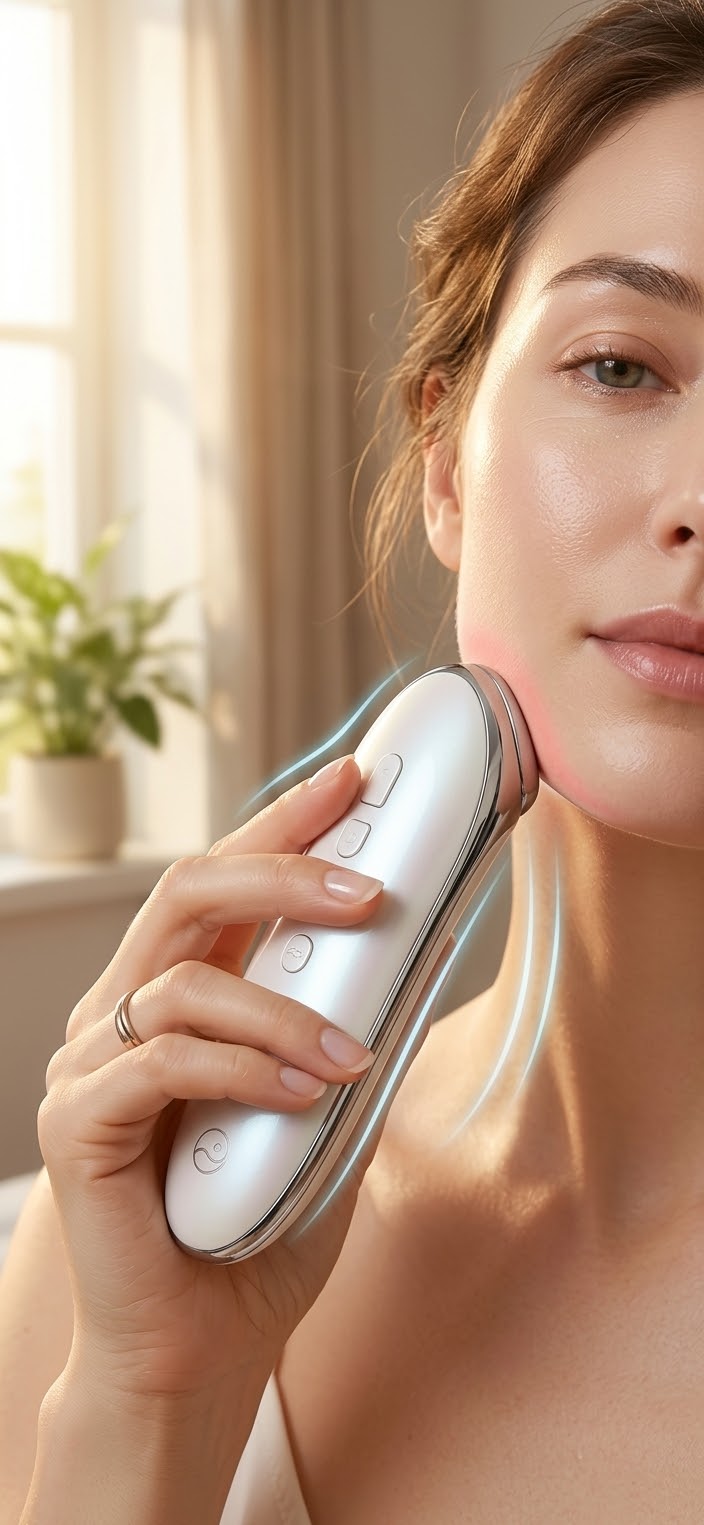
We make facial tools, so read the above as disclosure rather than distance. The reason our device procedures start at the outer corner and travel down the neck, rather than pressing inward under the eye, is this article: direction is the variable, and most routines get it backwards because they were designed around how cream is applied. The honest claim is small — this is a three-minute habit that shortens a self-resolving problem, not a treatment for one. [DEVICE] is in the photographs; the walking is the part that works.
Questions people actually ask
Is morning puffiness a sign of poor lymph drainage?
No. It is a sign that drainage was idle for eight hours. Lymph transit depends on muscle movement, breathing and gravity-assisted flow; lying still removes all three. The system resumes when you do.
Does drinking more water make it better or worse?
Neither, in any meaningful way. The fluid under your eye is interstitial, not dietary. Overnight retention is driven by sodium handling and posture, not by whether you drank a glass before bed.
Why is it always the same eye?
Because you sleep on that side. The dependent side accumulates more and drains more slowly. Swap sides for three nights; if the worse eye follows, the cause is positional.
Do cold spoons and ice rollers actually work?
Yes, briefly. Vasoconstriction reduces capillary filtration for thirty to sixty minutes. Keep it short — twenty to thirty seconds — because long, hard cold is followed by rebound vasodilation that leaves you puffier later.
How long should it take to go away on its own?
Forty-five to ninety minutes of being upright, faster if you are walking. If it is still there at lunchtime, the mechanism is not positional and the advice in this article does not apply to you.
Is under-eye puffiness ever fat rather than fluid?
Often, yes. Fluid changes within the hour and responds to posture. Orbital fat and a lax septum do not, and they are not affected by cold, massage or caffeine in any durable way.
References
Wiig H, Swartz MA. Interstitial fluid and lymph formation and transport: physiological regulation and roles in inflammation and cancer. Physiol Rev. 2012;92(3):1005-1060. PMID 22811424 (interstitial fluid balance; intrinsic lymphatic contractility and its dependence on surrounding movement).
Sundelin T, Lekander M, Kecklund G, Van Someren EJW, Olsson A, Axelsson J. Cues of fatigue: effects of sleep deprivation on facial appearance. Sleep. 2013;36(9):1355-1360. PMID 23997369 (observer-rated swelling of the eyes, not measured tissue).
Guyton AC, Hall JE. Textbook of Medical Physiology. 14th ed. Elsevier; 2020 (Starling forces, capillary filtration, nocturnal antidiuretic hormone and renin–angiotensin activity).
Standring S, ed. Gray’s Anatomy: The Anatomical Basis of Clinical Practice. 42nd ed. Elsevier; 2020 (orbital septum, periorbital areolar tissue, eyelid skin thickness, cervical lymphatic drainage).
Mortimer PS, Rockson SG. New developments in clinical aspects of lymphatic disease. J Clin Invest. 2014;124(3):915-921. PMID 24590286 (lymphatic function and the limits of manual drainage).
Rockson SG. Diagnosis and management of lymphatic vascular disease. J Am Coll Cardiol. 2008;52(10):799-806. PMID 18755302 (clinical approach to oedema and when swelling is not benign).


Comments
Post a Comment